Robbie Rorich
Where movement becomes memory
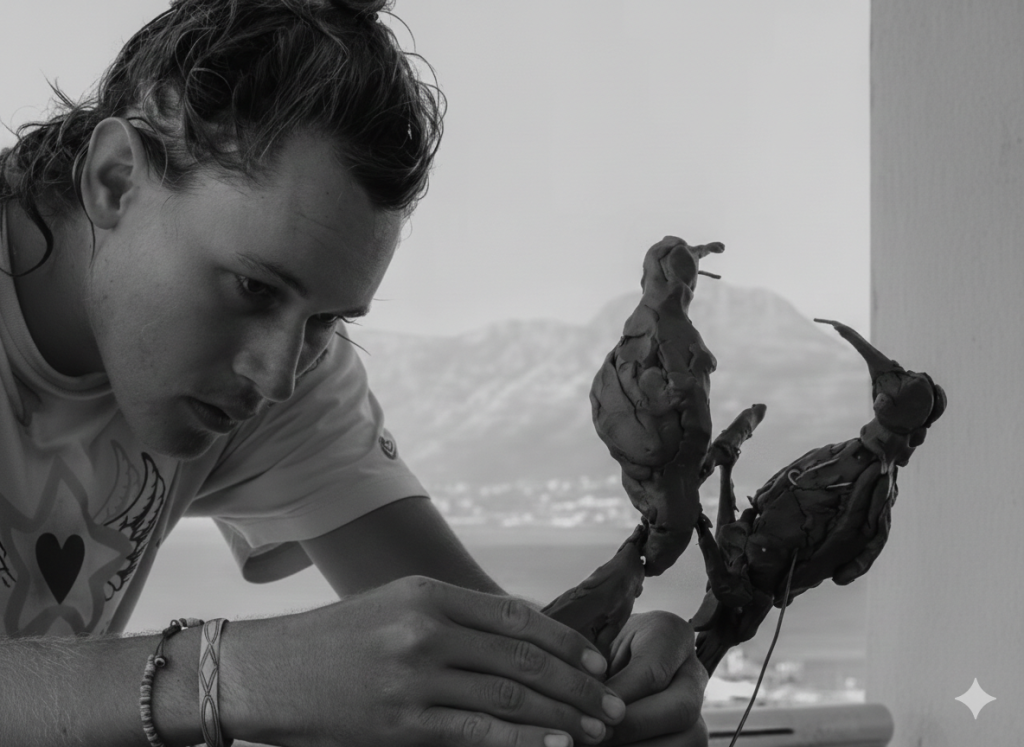
From the beginning, Robert Rorich — Robbie to those who know him — has been drawn to life in motion.
Growing up in White River, Mpumalanga, he was surrounded by people, open landscapes, and the rhythm of the bush. Curiosity defined his childhood. Lego constructions became clay life forms. Games in the garden became a love for trail running. Play evolved into purpose.
“I was fortunate enough to spend a lot of time in the bush,” he reflects.
Nature was not a backdrop — it was teacher, playground, and constant inspiration.
In high school, that inspiration found direction. Robbie fell in love with sculpture. What began as experimentation quickly became serious work. In his final years of school, he was commissioned to create a life-size bronze sculpture of two students for the school fountain — replacing a piece by one of his early idols, Dylan Lewis.
The sculpture is striking: two figures locked hand in hand, one inverted, a balloon floating downward. It questions gravity. It challenges perspective. Yet it radiates joy.
This balance defines Robbie’s work — thoughtful but optimistic, curious yet grounded.
A fascination with how the physical world works led him to study Mechanical and Mechatronic Engineering at the University of Cape Town. Engineering sharpened his understanding of structure, tension, balance, and force — principles that now underpin his sculptures.
But technical knowledge never replaced wonder.
Driven by adventure and curiosity, Robbie, his sister, and friends cycled the length of Africa — an experience that deepened his connection to people, wildlife, terrain, and the raw pulse of the continent.
Today, Robbie’s sculptures transform spaces by capturing what cannot be held: movement, energy, presence.
“I am in love with movement — human and animal bodies — and the positive energy that comes from the natural world around us,” he says. “There is no way of making a living entity more alive than it already is, but I hope that through my sculptures, animals and people are able to come alive in the space in which they are placed.”
His process is immersive. When sculpting, he speaks of being guided — of animals leading his hands, of energy surging through him for days at a time. Whether forming a crocodile or a Goliath heron, he approaches each subject with reverence and openness.
“I am quite sure it’s not just me who makes the sculptures.”
His works hold a sense of breath — as though the figure might shift, stretch, or leap at any moment. Muscles carry tension. Limbs suggest motion. Surfaces reflect both strength and sensitivity.
Engineering gives his sculptures structure.
Nature gives them soul.
Now exhibited in private collections across South Africa, Robbie’s work continues to evolve — grounded in the bush that shaped him, guided by curiosity, and driven by a deep love for all that is alive.
Robert Rorich does not simply sculpt animals and people.
He captures the moment just before they move.
Francois Viljoen
Where form becomes feeling
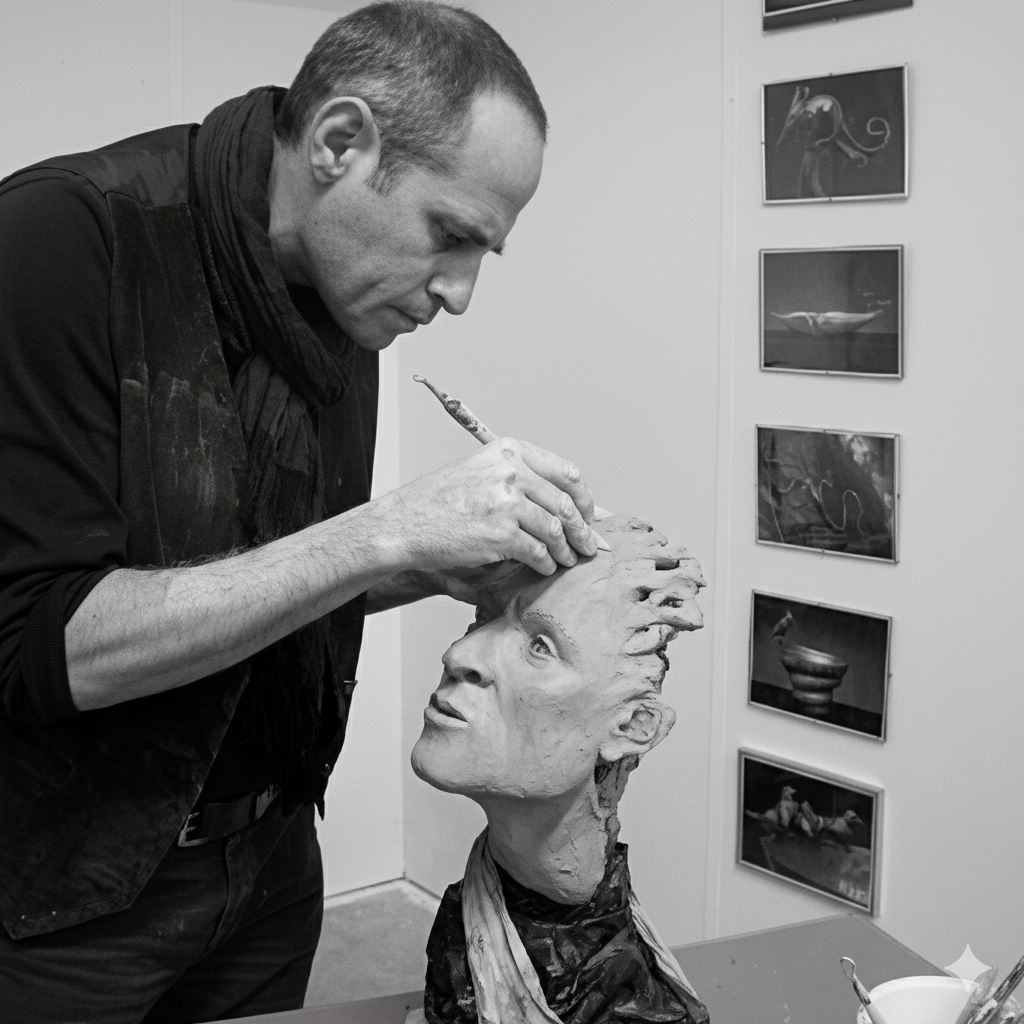
Francois Viljoen’s life has always been shaped by art — even before art formally shaped him.
Born in South Africa, Francois attended a school known for academics and sport, not creativity. There were no art classes. No structured outlet for expression. Yet something within him was already forming.
As a teenager, he discovered drawing — and with it, direction. Inspired by the television series Quest for Romanticism, he began to explore the deeper emotional and philosophical dimensions of art. What started as curiosity became calling.
“It was like finding meaning,” he explains. “Like bringing order to chaos, soul-wise.”
Art became his language.
Through graphics and early sculptures, he began expressing his understanding of life, faith, struggle, beauty, and the unseen forces that shape human experience. Even then, he was not merely creating images — he was translating emotion into form.
Today, Francois is a qualified and experienced art teacher, living and working between Germany and South Africa. His practice spans both continents, but his artistic voice remains rooted in something timeless.
He paints primarily in oil — drawn to its depth and richness — but also works in acrylic. He sculpts in ceramic, plasticine clay, and plaster, and casts in bronze and resin. Drawing remains foundational, executed in multiple media. His work moves fluidly between two-dimensional and three-dimensional expression.
The influence of Romanticism and Symbolism runs deep in his visual language. He is captivated by sacred geometry, by the organic forms found in nature, and by what he calls “the Creator’s breath-taking design.” The flowing elegance of Art Nouveau — known as Jugendstil in Germany — continues to shape his aesthetic sensibility.
For Francois, themes are not random.
His animal-themed works he calls “Songs.”
They are lyrical, instinctive, and intuitive — expressions of harmony and natural rhythm.
His human-themed pieces, including his “Performers” series, he calls “Shouts.”
They are bold, emotional, theatrical — reflections of tension, identity, and the human condition.
Whether sculpted in bronze or painted in oil, his works carry presence. They are not decorative; they are declarative. They invite reflection. They hold tension between strength and vulnerability.
Francois exhibits at respected galleries in South Africa, including the Everard Read Gallery (Cape Town), Grande Provence Gallery (Franschhoek), Ebony Curated Gallery (Franschhoek), and the Cape Gallery (Cape Town), as well as in Europe. Alongside exhibitions, he undertakes commissioned work in both 2D and 3D mediums.
But beyond galleries and mediums, Francois’ work is about something deeper.
It is about translating the invisible into form.
About shaping meaning from mystery.
About giving voice — whether in a whispering Song or a powerful Shout — to the inner life of the soul.
Robyn Campbell
Where conscience meets craft
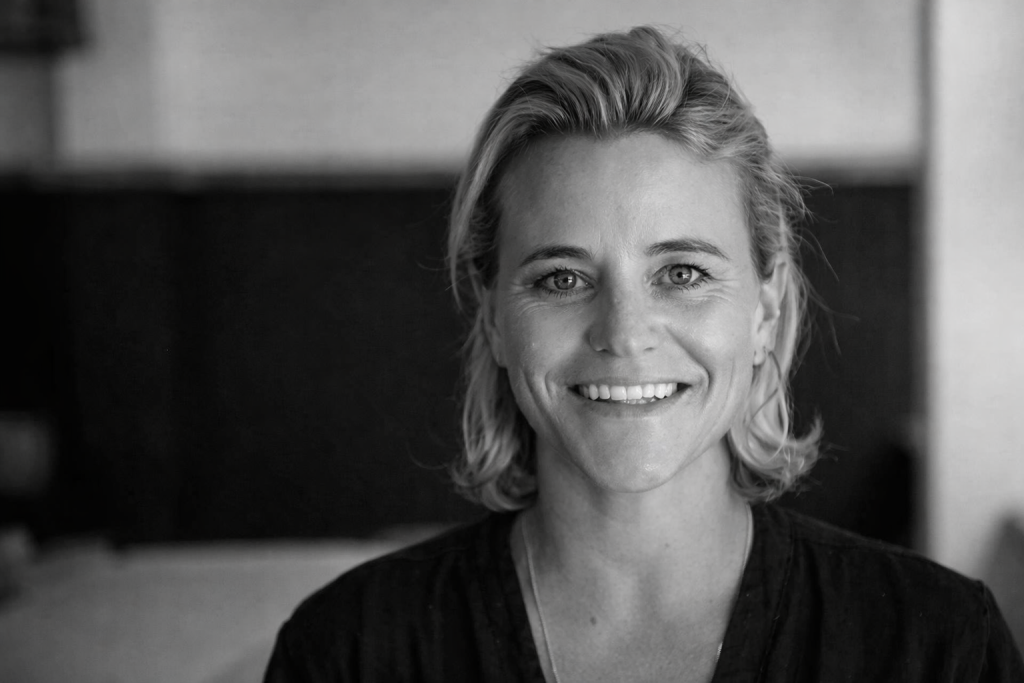
Campbell grew up close to the land.
Her early childhood in rural Limpopo, followed by years on a farm in the hills of Muldersdrift, shaped the way she sees the world. Nature was not scenery — it was teacher, provider, and responsibility. That connection never left her.
After studying brand communication at Vega School and spending time abroad — from a ski resort in Austria to working aboard a super yacht owned by the Getty family — Campbell returned to South Africa at 26 with clarity. She didn’t just want to build a business. She wanted to build something that mattered.
She began with wood.
Not pristine, untouched timber — but reclaimed wood. Forgotten beams. Weathered planks. Materials with history. She saw value where others saw waste. What began as a small venture crafting furniture from reclaimed and upcycled materials quickly became a design philosophy: nothing should be discarded without purpose.
Her style is rustic modern — grounded, textured, honest. Each piece carries its past into the present. Clean lines meet raw grain. Steel meets salvaged timber. Strength meets warmth. Her furniture doesn’t try to impress; it invites you in.
But sustainability for Campbell has never been a trend. It is conviction.
That same conviction led her to challenge an industry few dared to question. After a conversation with her father — a tobacco blender — she began exploring how to reduce the environmental damage caused by cigarette waste. The result was BARE, a fully biodegradable cigarette brand designed to lessen the impact of one of the world’s most pervasive pollutants.
In a heavily male-dominated industry, she was often told she was unrealistic. But she has always believed that small, deliberate steps create real change.
From furniture workshops to product innovation, Campbell’s approach is consistent: build responsibly, think long-term, and leave as light a footprint as possible.
Today, her furniture reflects the same values that define her life — sustainability, integrity, and courage. Each table, bench, and cabinet tells a story of renewal. Of materials reborn. Of beauty without excess.
Campbell doesn’t just design furniture.
She builds pieces with a past — for spaces with a future.